


Ripped athletes with a refreshing, sugar-free lemonade at their lips can't be lying, right? If you pay attention to your diet, you'll find that almost every product in the supermarket now comes in a “Light” or “Zero” version with no sugar. These are supposed to support a healthy lifestyle, but more and more voices claim that sweeteners and other sugar substitutes are unhealthy. Is there any truth to this? How do these sugar alternatives work and where can you find them? That's exactly what we want to take a closer look at in this article.
What are sweeteners and why do they exist?
Sweeteners is a collective term for natural, but often also artificially produced, chemical compounds that can be used as an alternative to conventional sugar in foods.
“When it comes to sweeteners, you basically have to distinguish between artificial sweeteners and sugar alcohols.”
Originally, artificial sweeteners were used as a sugar substitute in foods to provide an alternative for diabetics and people on a diet. The low energy values and the “healthy lifestyle” trend of recent years have led to the increased use of artificial sweeteners in foods.
In addition to artificial sweeteners, there are also so-called sugar alcohols. These are usually derived from plants and have a chemical structure similar to carbohydrates. They generally have a lower sweetness than regular sugar, but also a lower energy value.
How to recognize sweeteners in foods
Since sweeteners are legally classified as food additives, they must be labeled as such on product packaging according to EU regulations. Currently, the EU has approved a total of eleven sweeteners and eight sugar alcohols, which we have summarized in the following list.
These sweeteners are approved by the EU and must be labeled with their respective E-number on product packaging.
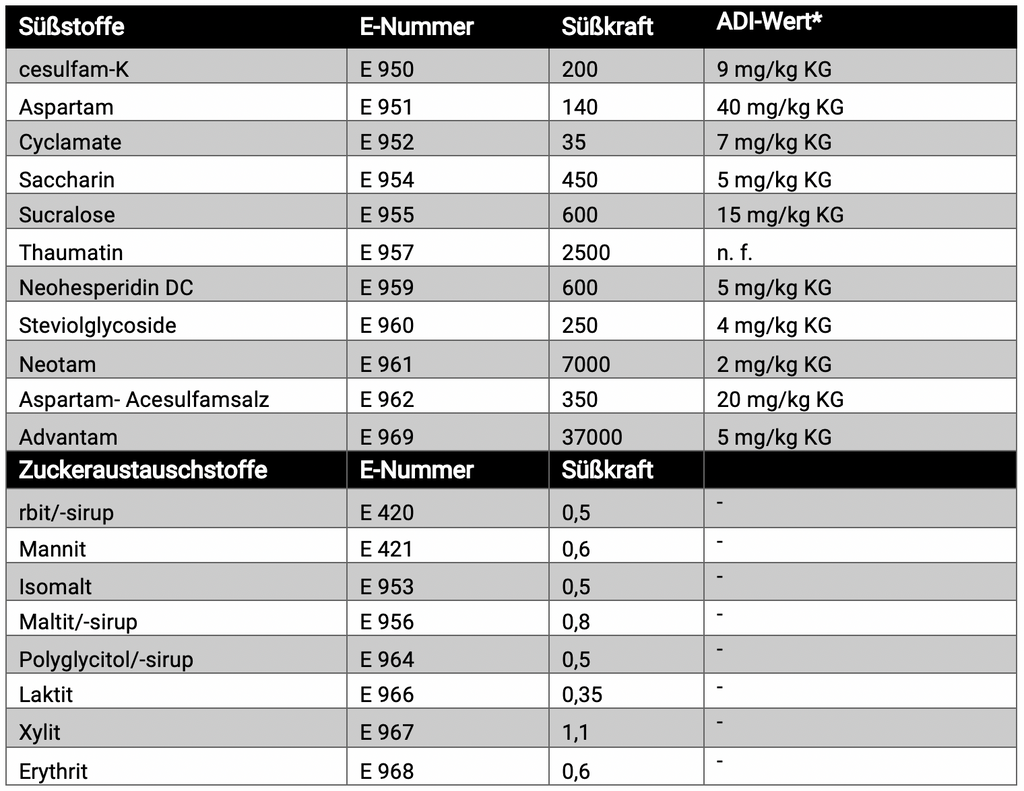
These sweeteners are approved by the EU and must be labeled with their respective E-number on product packaging.
* ADI (Acceptable Daily Intake) refers to the acceptable daily intake amount
The ADI value for sweeteners – safe, but not too much?
As an alternative to sugar, sweeteners are supposed to reduce calorie intake and lower the risk of cavities, but are they really healthier? While no ADI value has been defined for sugar alcohols, the EU has set such values for artificial sweeteners. This alone suggests that these substances might not be entirely harmless for the body, even if they don't cause direct harm. If you want to support your overall well-being through nutrition, sweeteners could get in your way.
Sweetener or sugar – what effect do they have on your body?
Choosing to eat healthier often goes hand in hand with increased consumption of sweeteners. That's mainly because many people don't want to give up the sweet taste. So what are the pros and cons, and which is healthier: sweetener or sugar?
Less cavities, fewer calories with sweeteners
Carbohydrates are generally an essential part of human nutrition and are needed for metabolism. Their basis is sugar molecules, which can occur in different forms.
The biggest advantage of sweeteners is obvious: they have virtually no calories, while sugar comes in at almost 4 kcal/g. Your teeth will also thank you for every gram of sugar you save, since sugar promotes the development of cavities. Better for your teeth and helps with weight loss – so what's the catch?
The disadvantages of sweeteners
First of all, studies on the negative effects of sweeteners are still new and are often criticized for having too small control groups. Most studies are also based on animal testing, where critics often claim the doses used are disproportionately high.
Still, the list of suspected side effects from sweeteners is considerable. They are thought to promote type 2 diabetes, where blood sugar levels can't be regulated by the body's own insulin. Links to an increased risk of cancer are also being investigated.
Changes in gut flora have already been observed in animal studies, for example. This can also occur indirectly through changes in food intake, which could be linked to an appetite-increasing effect of sweeteners. Increased appetite means that even if you avoid sugar, you could still gain weight if you're not mindful of the quality of your increased food intake.
Stronger taste – but less flavor
In our table above, you’ve probably already noticed the column titled “Sweetness” – but what does it mean? Sweetness indicates how much sweeter a sweetener is compared to regular sugar. For most substances, the values are in the thousands to tens of thousands range.
“If you consume sweeteners frequently, you can hardly perceive the taste of natural foods anymore.”
Strong sweetness alone isn’t necessarily a bad thing, but it does mean you get used to it. If you consume sweeteners often, you can barely taste the flavor of natural foods anymore. This leads to natural sweetness, like that found in fruit, hardly being noticeable, so people often reach for artificially sweetened products instead.
You could almost call it a dependency, because everything else just doesn’t taste as good anymore. But if you cut out sweeteners completely for a short period, you’ll quickly notice your sense of taste returning.
Even if many of these studies haven’t been fully proven yet, you should try to avoid or completely cut out artificial additives if you want to eat consciously. Wondering if there are natural and healthy alternatives to sugar and sweeteners?
Are there natural sugar alternatives?

That’s a clear “yes” from us. There are plenty of natural alternatives to sugar that don’t come from a lab or need their own E-number. To add sweetness to your recipes without sugar, you can use these ingredients:
Depending on your taste and how you want to use them, you’ve got plenty of options to sweeten your day. If you’re like us and go for ORGANIC, you’ll want to find ways to sweeten your day without consuming artificial additives. By the way, ORGANIC certification according to the EU organic regulation requires avoiding sweeteners. That makes it easy to see what you can pick up when shopping and what you might want to leave on the shelf.
Better a healthy sweet life than an artificially low-calorie one
No question, not everything about sweeteners is negative and the basic idea isn’t a bad one. But if you want to add sweetness to your diet in a healthy and authentic way, you should avoid sweeteners. The long-term effects on your body – which you obviously care a lot about, otherwise you wouldn’t be reading our blog – are just too unclear. Put “artificial” aside and sweeten your life naturally.
Cover image: Maxmann