


Germany is internationally known for many things, but not so much as a land of cows. Yet, Germany is home to nearly 4.2 million cows, whose living standards can vary greatly. The often-marketed image of the “pasture cow” roaming freely on grass does exist, but the term often obscures more than it reveals.
This article explores the different forms of cattle husbandry, what pasture grazing means for cows in Germany, and the regulations that apply.
What types of cattle husbandry exist for German cows?
If you visit agricultural businesses across the various German states, you’ll encounter different types of cattle husbandry. The following forms are widespread and usually depend on the structure of the farms themselves. That’s why mixed forms are often used.
“Nearly 25 percent of Germany’s dairy cows live in conditions that are not species-appropriate.”
Tethered Housing – Factory Farming of Cows
In this form of husbandry, cows are tethered and remain in a fixed spot. The tethering must at least allow them to eat, stand, and lie down at any time. This is a form of factory farming that lacks any trace of species-appropriate living and is heavily criticized by animal welfare advocates. Although the proportion is steadily decreasing, nearly 25 percent of Germany’s dairy cows still live in conditions that are not species-appropriate.
Free-Stall Housing – the Balanced Mix for Dairy Cows
 With free-stall housing, cattle have the opportunity to move freely between sleeping and feeding areas all day long.
The shared apartment for cows—that’s one way to describe free-stall housing, where the animals share a large barn and can move around freely. Eating and resting areas are separated and equally accessible to all animals. The necessary social contact between cows is not restricted. If the free-stall barn can be connected to a pasture, the animals benefit from additional outdoor access.
Pasture Grazing – as species-appropriate as it gets for livestock
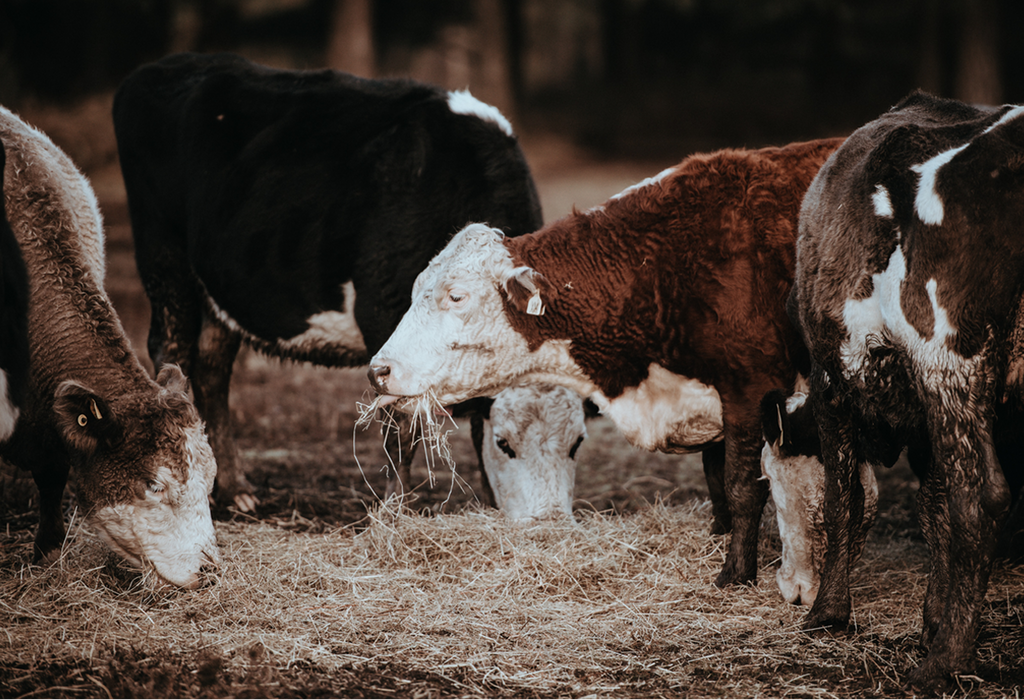
Ideally, pasture grazing means cows spend most of their time outdoors on pasture. Here, they eat mostly fresh grass and are brought into the barn daily for milking, where they also have access to resting areas and additional feed. Since year-round pasture grazing is usually not possible, about 75 percent of German farms use a mixed form of free-stall and pasture grazing.
Hay Milk and Pasture Milk from Cows on Pasture
Brochures, commercials, and product packaging often paint a misleading picture: happy animals, kept in species-appropriate conditions, making sure we lack nothing. Terms like hay milk and pasture milk may sound very similar, but in the end, they’re often used to avoid a protected term. So what are the differences, and what rules apply to each?
Hay Milk – an EU-Protected Term
Since March 2016, the term hay milk has been legally protected throughout the EU. It means that hay milk comes from cows that are fed fresh grassland forage. Hay and grains are the main food sources, and the use of silage is strictly prohibited. The corresponding EU label is: “Traditional Speciality Guaranteed” (TSG). The minimum criteria for using the TSG label are defined in the Implementing Regulation (EU) 2016/304.
Pasture Milk – an Unprotected Term Without Guidelines
While the term “hay milk” is clearly defined, the situation is completely different for “pasture milk.” The word is meant to suggest that the dairy cow spends its life on pasture. But since the term is neither protected nor regulated, it’s simply a marketing tool.
By the way: The term has already led to legal disputes, where a court at least defined the following conditions that must be met for “pasture grazing”: Milk from cows that spend at least 120 days a year, six hours a day on pasture, may be marketed as pasture milk. There are no clear rules about feed, inspections, or winter conditions. So the term leaves a lot of room for interpretation and is often used to mislead consumers.
EU Organic Regulation – Standards for Organic Food Production
Since 1991, the EU has been developing rules and guidelines for the production of organic food under the EU Organic Regulation. These include regulations on production, import requirements, food inspections, and labeling. The EU Organic Regulation currently sets the highest standard for organic food production and applies to both plant and animal products.
By 01/01/2021, a revised version of the EU Organic Regulation, the ORGANIC Regulation, is expected to be in place. From 2021 onwards, all ORGANIC control bodies must enforce it. Its purpose is not only to ensure product quality, but also to raise animal welfare standards.
The Life of a Cow as a Farm Animal
Cattle play two key roles in agriculture, depending on their sex. Female cows are used for milk production, while males are raised for meat.
For a cow to produce milk regularly, she must calve every year. That’s why they are usually artificially inseminated. When a cow gives birth, the calf is separated from her within the first few days and temporarily housed in a calf box, also known as a calf igloo. After separation, the cow rejoins the dairy herd. After a few weeks, or at most two months, the calf is moved to the young cattle herd.
Male calves are fattened for about 18–24 months until they reach slaughter weight. Female calves, on the other hand, are raised to become dairy cows. The average lifespan of cows is about four to five years, which is twice as long as that of male cattle.
Mother Cow Rearing – the Most Natural Form of Husbandry
We also want to mention mother cow rearing, which is considered the most natural form of beef cattle husbandry. Here, the mother cow and calf stay together for up to 9 months. The cow is not milked and spends most of this time with her calf on pasture. After 10 months, the young animal is raised for meat production, and the mother is inseminated again after about a month’s break.
Beef and Dairy Products as Part of a Healthy Diet
Especially in sports and fitness, meat and dairy products are key protein sources for building muscle. For us at Orgainic, it was a given to use only regional dairy products with guaranteed best animal welfare.
Shopping consciously and taking a closer look at the origin and production of your food is not just about sustainability, but also about the quality of your nutrition and supporting your healthy lifestyle. Do something good for yourself, the cows, and the environment by choosing high-quality products from your region.
Tip: If you want to learn more about healthy eating, check out our article “No More Additives in Food – Time to Feel Good.”
Cover image by Nietjuh