


5.33 billion euros in revenue was generated by the German fitness industry in 2018. But you can still save yourself the cost of a gym and a personal trainer. For your individual fitness goals, you can create your own science-based training plan and give yourself a way to make your progress measurable.
No matter how different we are as people, our bodies always work according to the same principles and can be strategically trained just like projects at work or goals in your personal life.
In this article, you'll learn:
- What types of training are there?
- How do you align your training plan with your goals?
- How can you structure your fitness plan?
Step 1: Muscle building, dieting, or increasing endurance – what's your goal?
You might have already guessed it. The very first question you need to ask yourself before you start creating your training plan is: “What is my goal?” Since you probably have one in mind, write it down. It’s perfect as the first line of your training plan so you don’t lose sight of it and can remind yourself whenever you need to.
Tip: Define your goal as specifically as possible and use measurable values.
“I want to lose weight” or “I want to build more muscle mass” are goals, but unfortunately not very promising ones. Make sure to use measurable values, because if you can’t measure the progress you’re making along the way, how will you know when you’ve reached your goal?
A clear goal for a muscle-building training plan could be: “I want to gain a total of 3 kilograms of muscle mass in three months with four workouts per week.”
That’s realistic, clearly defined, and a challenge you’ll really have to dig into – perfect.
Step 2: Where are you now and what resources does your fitness plan need?
To keep your motivation high and make sure you stay on track, you need to see progress. So you don’t miss out, it’s best to note your current stats that you want to work on. Depending on your goal, these could be different things, such as:
- Body weight
- Maximum running distance or average running pace
- Body fat percentage
- Measurements of hips, biceps, chest, etc.
- Muscle mass percentage
Tip: For determining body fat and muscle percentage, it’s best to use a high-quality body composition scale and take several regular measurements throughout your training period.
As with any project, there are also external factors. To make sure these don’t become obstacles or catch you off guard, you should consider them too. So don’t just plan what you want to change, but also how, and ask yourself the following questions:
- How often can and do I want to train: Are you working or taking care of your kids and therefore have limited time?
- Where will I mainly train: At home or outdoors?
- What do I need to implement my training: What materials and equipment do I need to get before I can start?
Questions answered? Then you can move on to the third phase: the content of your training plan.
Step 3: How should you train: Split or full-body training plan?
There are basically two types of training plans that differ in terms of the body areas they target. Whether a full-body workout or a split training plan is better for you depends mostly on your goal and your training frequency.
If you’re working out one to three times a week, it’s best to go for a full-body workout. If you’re working out more than three times a week, a split training plan is the way to go. What does that mean?
The Full-Body Training Plan
As the name suggests, a workout here consists of exercises for all body areas. This way, both legs and upper body including arms can be trained in one session. Usually, you’ll need a slightly longer recovery phase, meaning more rest between workouts. That’s why this plan is more suitable for a lower training frequency.
The Split Training Plan
If, for example, you train legs one day and arms another day, that’s called split training. Since you’re working different muscle groups in each session, you can train more often without negatively affecting your recovery. For example, there might be three days between two leg workouts, with a back and arms session in between. So a higher training frequency is no problem.
Step 4: Reps, sets, and intensity – the right combination
Now that we’ve defined your goals and training plan, let’s tackle the question: “How many sets and reps should I do per exercise, and what intensity is right?” Again, your goal will help you answer this, but first let’s take a closer look at the three basic types of training.
Endurance Strength Training – The Workout Plan for Beginners and Newcomers
If you have little to no experience with regular workouts, you should start with a full-body training routine. This will give you a solid foundation for future goals and boost your overall fitness. It's great for improving basic endurance as well as for weight loss. If you already have a good level of general fitness and want to build on it, you can try one of the following two training methods.
Hypertrophy Training – Workout Plan for Muscle Building
This type of training is great for bodybuilders as well as anyone looking to generally improve their fitness level. You can steadily build muscle mass and also reduce your body fat percentage this way.
Maximum Strength Training – Workout Plan to Increase Strength
Weightlifters are the ultimate example of maximum strength training. They constantly have to push their strength limits and train solely to take their maximum strength to the next level.
The Key Metrics of Your Training Plan – Sets, Reps, Rest, and Intensity
You know where you want to place your training plan? Then let's get back to the question of what your training plan should actually look like. 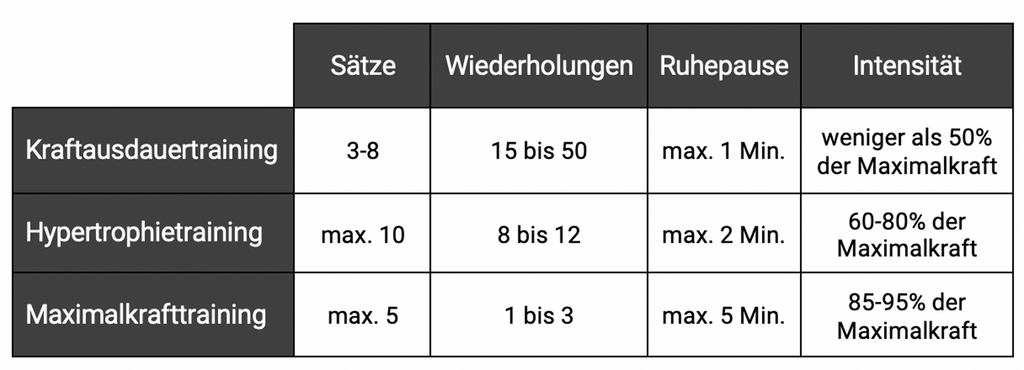 The table shows the recommended number of sets, reps, and intensity depending on the training method you choose.
Which Exercises Belong in Your Fitness Plan?
Of course, you can make any workout as complex as you want, but certain basic exercises should be included in every program. We've listed a few fundamental exercises for you, so you have plenty of options when creating your training plan. 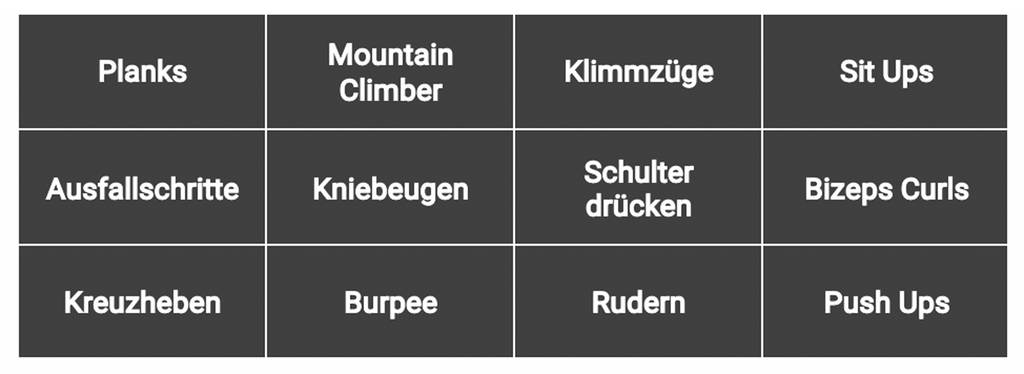 This table shows you basic exercises that should be part of every workout.
Even with just these basic exercises, you can create a very effective full-body workout plan. And you'll see how quickly you can get in shape with our sample routine for a simple full-body workout.
Tip for beginners: Free weight training and bench presses are also very effective chest exercises to help you reach your goals. Here, you can train your maximum strength without needing extra equipment like resistance bands.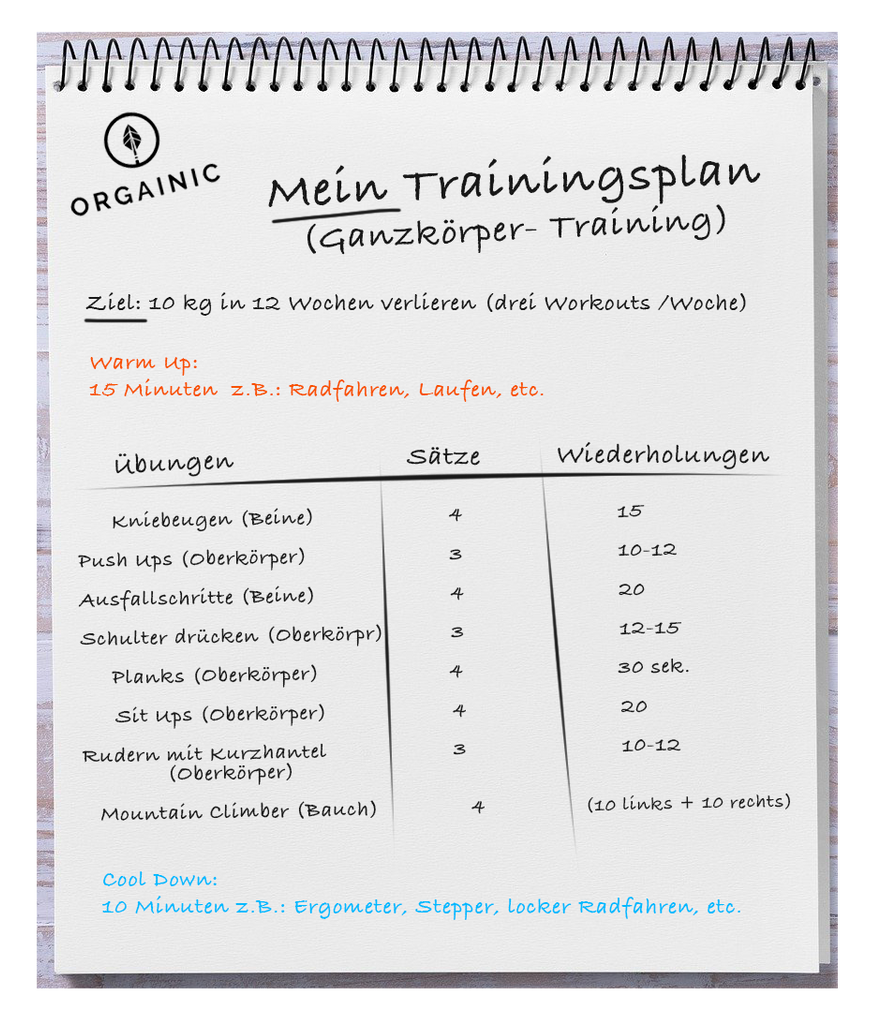
This is what a full-body workout plan could look like.
Create Ideal Conditions for Your Body
If you want to get your body in top shape, you're asking a lot from it. Your energy consumption increases, your muscles are put under more strain, and recovery becomes a key part of your progress. Rest and a healthy diet help your body recover faster, build muscle, and replenish energy stores. That's why you should make sure your training plan is ideally supported by a nutrition plan. This ensures you get enough energy and all the important, high-quality nutrients you need to make progress.
“It's only through the balance of proper nutrition and a strict training plan that you get the most out of your workout.”
That's why a healthy lifestyle always goes hand in hand with a healthy diet that supports your athletic activity. High-quality organic whey proteins can speed up muscle growth and shorten recovery time. For quick energy, the Organic Whey Protein Bar is perfect, giving you the carbs you need for an intense workout.
It's only by balancing proper nutrition with your training plan that you'll get the very best out of your workout. Feeling motivated? Then grab a pencil and notepad and start creating your very first personal training plan.
Title graphic by Sven Mieke. Graphic of the three training types by Markus Henien.